
Principles of Effective Learning and Teaching
The six interrelated principles that Southfield staff consider when planning great learning and teaching.
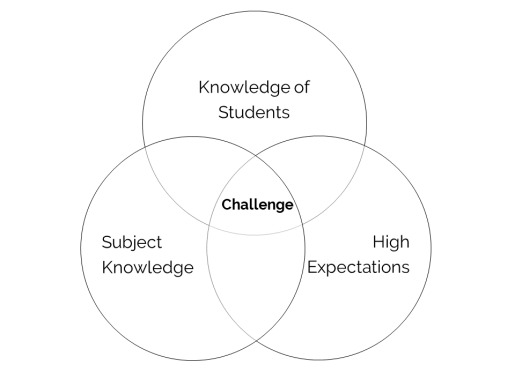
Challenge is not a 'learning activity' or 'more work' when you are finished. Challenge is not just making questions 'harder'.
At Southfield we recognise that challenge is created through the use of; effective explanations, models, scaffolds, questions, practice and feedback. Challenge is all of these wrapped in a culture of high expectations, positive relationships and purposeful learning environments.
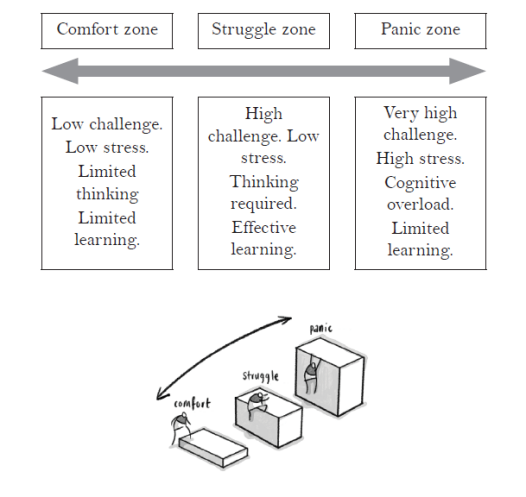
Challenge is about pitching our students into the struggle zone as regularly as possible (see the picture below from 'Making every lesson count' - Allison and Tharby). Learning is unlikely to happen in the comfort zone as students are not thinking hard enough about the material in order for it to be retained. Equally once the challenge gets too high students enter the panic zone and will shut down to what we are trying to teach them. This is in large part due to cognitive load, as when we overload students with information their limited working memory (in which almost all information is lost within after 30 seconds) will not contribute to the formation of long-term memories.
The team at Durrington Research School suggest that 'everyday challenge' can be ensured if we:
-
Prioritise learning over performance
-
Space it out and keep coming back
-
Set single challenging objectives
-
Get them thinking hard
-
'Know thy subject'
-
Use challenging vocabulary
-
Set the benchmark early
-
Share excellence
This full length blog by Shaun Allison of Durrington gives a solid explanation of what challenge looks like in the 'everyday classroom'.
Useful external blogs

At the core of a great teacher’s skill-set is the ability to explain the concepts, theories and techniques that form their subject. These can seem relatively simple to the expert teacher, but to the novice learner, these complexities can be completely alien to them. There is no doubt that teachers who explain things well, making the complex simple, allow for novice learners to learn in depth, gaining inspiration and a passion for the subject.
Tom Sherrington states:
‘As teachers, for high quality explanations to be habitual, we need to know our subjects, taking time to develop our own capacity to explain the key concepts simply. I think departmental CPD time would be well spent with colleagues rehearsing the ways they explain the more difficult material. Too often we assume we can do this but, over the years, I’ve found this is a key area for improvement and experimentation, for me personally and for others.’
At Southfield, staff have dedicated curriculum planning and subject knowledge sessions on a Wednesday afternoon. As part of this time, they work together to think through explanations thoroughly, sharing ideas/methods to improve. Explanation that isn’t well planned is likely to become muddled and unclear, the opposite of what great teaching is trying to achieve.
You can find out more on how Subject Planning and Development Sessions work, from their original source, Durrington Research School, here.
Books in our Professional Learning Library
-
How to explain absolutely anything to anyone – the art and and science of explanation – Andy Tharby
-
Why Don’t Students Like School? – Daniel Willingham – is an outstanding book that grounds effective explanations in scientific evidence.
-
Chapter 2 on ‘explanation’: Making Every Lesson Count – Shaun Allison and Andy Tharby
-
Chapter 11 on ‘Exemplary explanations’The Confident Teacher – Alex Quigley
-
Rosenshine’s Principles in Action – Tom Sherrington
-
Dual Coding With Teachers – Oliver Caviglioli
Useful External Blogs
Scaffolding and modelling allow the expert teacher to support and stretch the novice learner.
Modelling and scaffolding are so important because they:
-
set a benchmark for excellence, by showing students the quality they should be aspiring to.
-
make abstract success criteria concrete. Simply telling students what the success criteria are, or writing them down can be relatively meaningless for students. They need to be able to see what they are aiming for.
-
excavates the thought processes of experts – ‘what to do’ and ‘how to think’ (metacognition). Modelling our thinking with them, helps them to develop their thinking e.g. by them seeing us overcoming struggles, it makes it OK for them to struggle.
-
Induct students into academic genres of writing. Many of our students live in a household where academic language is not routinely used – so we need to model this for them.
Source: Shaun Allison. Read the whole blog post here – Modelling – how, why and what can go wrong?
‘Provide models: Providing students with models and worked examples can help them to learn to solve problems faster.’
Barack Rosenshine Principles of Instruction
Books in our Professional Learning Library
-
Chapter 3 on ‘Modelling: ’Making Every Lesson Count' – Shaun Allison and Andy Tharby
-
Chapter 11 on ‘The Power of Modelling’: Slow Teaching – Jamie Thom
-
Chapter 13 on ‘Successful modelling and metacognition’: The Confident Teacher – Alex Quigley
-
Chapter 2 ‘ on Modelling’: Mark. Plan. Teach – Ross Morrison McGill
-
Technique 39, ‘Show Call’: Teach Like a Champion 2.0 – Doug Lemov
-
How to Explain Anything to Anyone – Andy Tharby
-
Rosenshine’s Principles in Action – Tom Sherrington
Useful External Blogs
-
Why I love writing at the same time as the class – Susan Strachan
-
Using a visualiser to support modelling – Jack Tavassoly-Marsh
-
How to use modelling successfully in the classroom – Andy Tharby
-
Applying Cognitive Load Theory – The Worked Example Effect – Tom Needham
External Videos
Questioning is one of the most integral characteristics of effective teaching and learning as it:
-
drives learning
-
creates a language rich environment
-
encourages engagement and motivation
-
develops critical thinking
-
reviews learning
-
assesses understanding
-
informs planning
‘Ask a large number of questions and check the responses of all students. Questions help students practice new information and connect new material to their prior learning.’
Barack Rosenshine Principles of Instruction
Books in our Professional Learning Library
-
Chapter 7 – Classroom Talk and Questioning – ‘What does this look like in the classroom’ – Carl Hendrick and Robin Macpherson
-
Chapter 6 – Questioning – ‘Making every lesson count’ – Shaun Allison and Andy Tharby
-
Chapter 7 – Building ratio through questioning – ‘Teach Like a Champion 2.0’ – Doug Lemov
-
Chapter 6 – Questioning: Rediscovering the potential – ‘Slow Teaching’ – Jamie Thom
-
Pages 195-208 – The Learning Rainforest – Tom Sherrington
-
Chapter 12 – Confident questioning and feedback – ‘The Confident Teacher’ – Alex Quigley
-
Techniques 11 and 22 ‘No Opt Out and Cold Call – ‘Teach Like a Champion 2.0’ – Doug Lemov
-
Rosenshine’s Principles in Action – Tom Sherrington
Useful external blogs
-
What does research evidence tell us about effective questioning? – Andy Tharby
-
Why we shouldn’t allow students to ask questions whenever they want – Ben Newmark
-
Questioning for confirmation and then challenge – Sarah Donarski
External Videos
At Southfield, we realise that great explanations, modelling and questioning will only have the desired impact if students are given well-planned opportunities to practice using their knowledge and skills.
Students need time to rephrase, apply, elaborate and summarise new material in order to aid its transfer into the long term memory. It is important students are challenged whilst continuing to enjoy a relatively high success rate to aid retention of new knowledge.
Furthermore, it is essential that students are clear about the success criteria against which this deliberate practice is to be evaluated. This will inevitably lead to meaningful feedback and student reflection.
In their book 'Making every lesson count', Allison and Tharby give a clear 'practice continuum' that can illustrate how this will look in the classroom:
Practice Continuum
Dependence
Teacher explains and models content. Students are mainly listening, watching and taking notes.
Heavy guidance
Teacher leads practice through questioning, discussion and supports. Students’ cognitive work is shared with the teacher
Light guidance
Students are doing cognitive work on their own with regular teacher feedback and fewer supports
Independence
Students work with and apply new knowledge for an extended period without teacher support. All cognitive work has been passed to the student.
Autonomy
Students fluently manipulate knowledge and skills independently by applying them to new contexts
Retrieval Practice - the act of having to 'retrieve' something from your memory (often with the help of a cue).
Staff at Southfield have been developing this aspect of student practice across the curriculum. Research supports the idea that retrieval practice strengthens long-term memory. This is known as the 'testing effect'.
Every time a memory is retrieved, that memory becomes more accessible in the future. Retrieval also helps us create coherent and integrated mental representations of complex concepts, the kind of deep learning necessary to solve new problems and draw new inferences.
A really useful starting point to understand retrieval practice is the work of the Learning Scientists.
The Science of Learning – Deans for Impact is also a great overview of how students learn and the implications this has for how we teach.
Books in our Professional Learning Library
-
Chapter 4 on ‘Practice': Making Every Lesson Count – Shaun Allison and Andy Tharby
-
Rosenshine’s Principles in Action – Tom Sherrington
Useful external blogs:
-
The role of retrieval practice in the classroom – Firth, Smith, Havard and Boxer
-
How to improve retrieval practice – good to great – Ben Newmark
-
Retrieval Practice in the Collaborative Setting – Blake Havard
-
Retrieval Practice – the what, why and how of total recall… – Robin Launder
-
The critical role of retrieval practice in long term retention – Roediger and Butler
-
Retrieval Practice, the most powerful teaching strategy that you’re not using! – Jennifer Gonzalez
-
Where does retrieval practice sit with formative and summative assessment? – retrievalpractice.org
-
A powerful way to improve learning and memory – Jeffrey Karpicke
-
The benefits of spaced practice in the classroom – Megan Smith
At Southfield we have moved away from ‘marking’ and towards a ‘diet of feedback’. Each department has created their own feedback and assessment policy, in line with the whole school feedback policy.
It is important to diminish the view that a 'really well marked book' is an effective proxy for a great teacher. If nothing is done with the feedback that is provided, then the feedback is pointless, has wasted the teacher’s time and has massively increased their workload.
Staff are encouraged to use a variety of feedback techniques to help students move forward. This feedback must always be 'managebale, meaningful and motivating'.
Southfield students are also taught and encouarged to give and receive feedback from each other.
‘Feedback is one of the most powerful influences on learning and achievement’ - Hattie & Timperley, 2007
Books in our Professional Learning Library
-
Chapters on assessment and feedback: What does this look like in the classroom? - Carl Hendrick and Robin MacPherson
-
Chapter 5 – ‘Feedback’: Making Every Lesson Count – Shaun Allison and Andy Tharby
-
Chapters XXX Mark. Plan. Teach. – Ross Morrison McGill
-
Embedded Formative Assessment– Dylan Wiliam
-
A Marked Improvement – Education Endowment Foundation
-
Rosenshine’s Principles in Action – Tom Sherrington
Useful external blogs
Teacher feedback:
-
What do do after a mock: Assessment, sampling, inferences and more - Adam Boxer
-
Valuable feedback that supports teacher wellbeing – whole-class feedback – Rebecca Foster
-
How can sampling improve the frequency of feedback and inform teaching more regularly?– Quirky Teacher
-
What if you marked every book, every lesson? – Harry Fletcher-Wood
-
Ensuring the feedback has actions for students – Tom Sherrington
-
Making Good Progress – the future of assessment for learning – Daisy Christodoulou
-
Top 10 strategies for questioning and feedback – Alex Quigley
-
Testing in the classroom and the importance of feedback – Carissa DiPietro
Self and peer feedback:
-
How to ensure peer assessment works – Teacher Toolkit
Useful video clips: